Tenerife Wildlife - Is it all in the wild?
Yes, what wildlife?
Although Tenerife is only roughly 100 miles from Africa, it has hardly any wild creatures.
At least, not on land. The ocean is different.
What about all those countless interesting lizards?
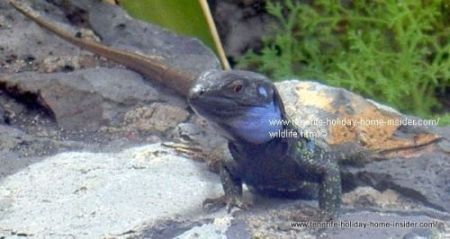
My favorite is a Gallotia Galloti Eisentrauti a
Tenerife wall lizard which I encountered in 2014 at San Pedro Los
Realejos. It was a fully grown almost 16 inches long male with the most
stunning blue throat. Those wall lizards are also part of the
oldest species of wild creatures of Tenerife. They have evolved on the
biggest of all Canary Islands, since they have made it to shore, 20
million years ago.
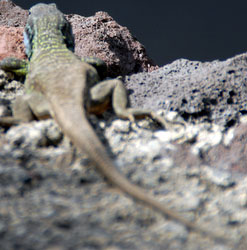
Look at a slightly younger species of this Tenerife lizard of the
West Coast. The bellies of males are blueish and females are rather of a
mauve brown.<p>
The picture of this one was taken by the
Rambla del Castro of Realejos. It is the type, which a friend and I
have fed with overripe bananas in Parque Taoro in the middle of its residential area.
The wildlife of the lizards is not an easy one. Wild stray cats are a great threat.
The Galotia lizard of Tenerife is also prominent in the far north in the Anaga mountains and in its nearby Mercedes forests.
Tenerife Lagarto Lizard news
On February 26, 2013, I saw this blue and black male
lizard by the protected spaces of Playa Jardin's endemic cactus park. It
was 1,5 inches wide by about 6-7 inches long (4,5 cm x 20 cm).
This is rather huge for Tenerife North lizard standards.
The amazing noise which it made in dry undergrowth drew my attention.
A tamed lizard
Or what lizards eat besides fruit
Such a North lizard once found its way onto my neighbors' balcony. This creature, which had lost its tail became tame and ate flies out of my neighbor's hand. Just figure that he hunted for flies for it every morning.
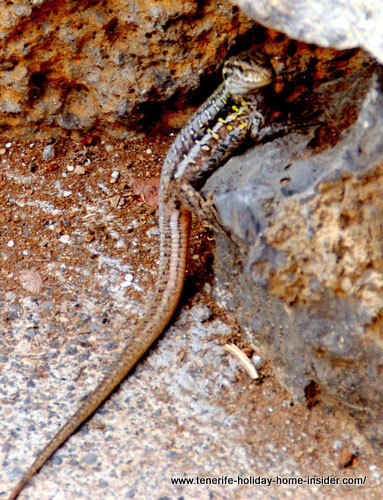
The neighbor remembers that the little lizard teeth were rather sharp,
while it looked at him like a mini crocodile. Once, it almost bit him.
It may have been a cat which had attacked this lizard. Rats are usually not that dangerous for it. They are not fast enough.
The Southern Tenerife lizard
Admire this beautifully freckled lizard of Tenerife in the photo on your right.
This one may have been 50cm (about 16 inches) long, if I remember well.
It is a male lizard called Gallotia Intermedia.
It may cross your path in the Teno mountain region or by Mount Teide or in its Cañadas.
However,
we captured this one a further down from Spain's highest peak, while we
had drinks in a little outside Bodega Café, which had a rock garden.
This dotted lizard may reach close to one meter in size, where the tail makes up most of it.
See
how it looks at you in the picture beside, all curious... Its yellow
dots seem to glow, while blue also adorns its reptile coat.
All
Tenerife lizards are wall lizards. I call them rock lizards. You
discover them, wherever you walk outdoors near stones and even rubble.
It is not easy to catch one on camera, unless it is sun bathing and half
asleep.
A giant on El Hierro which is part of Tenerife province
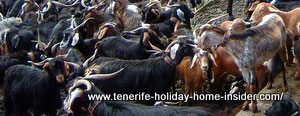
The wildlife of Tenerife goats
There are many indigenous goats on the island. Most are brown, others are black and white. A cute goat picture
with a most most stunning mix of goat coat colors and facial expression
by a Tenerife mountain goat is a good example... Some of the mountain goats
are bigger and their babies are simply cute. Without goats milk
Tenerife would not have many a prize cheese. Mind, those agile animals
who can go, where you can't, often endanger delicate, wild herbs in
gorges called 'Barrancos' or in other remote spots. Are goats part of
Tenerife wild animal life? Yes, so to speak.
Tenerife
goats are at home in rough country by the ocean or in altitudes but are
not allowed in the National Park. They are the semi wildlife which
blocks your path often, when you get a little off the beaten track. They
always have right of way.
They were already around, when the neolithic Guanches reigned the island. Spaniards could learn much about how to keep goats from them, but preferred them to look after the animals. By the way, the Guanche counting system was based on goats.
Legal Hunting or culling of Mufflons
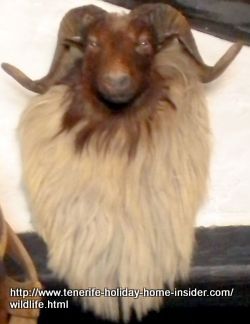
About 100 Mufflons roam wild in the Cañadas del Teide and surroundings. These goat hybrids of nearly 100 pounds have reproduced fast since they were introduced in 1970. Their only enemy is man who is allowed to shoot them on set days in spring and autumn, only. Many a hiking path is off limits, then.
Mufflons destroy the Tenerife ecological system by feeding on indigenous plants. The following shows what those wild animals are like.
The wildlife hunting law and licenses
A must for your own benefit are the government law and conditions to hunt small or bigger animals in Tenerife, such as the Mufflon which
find here...
The wild Tenerife bee and the honey bee
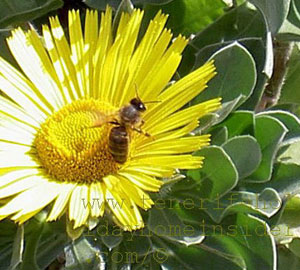
It's hard to distinguish between Tenerife
honey bees or just flower bees. Mind that the honey bee by Teide
delivers one of finest mountain honeys. Close to 500 bee keepers sell
this bee nectar in all kinds of forms to the shops of the Canary
Islands.
African bees are said
to have invaded Tenerife at some rare points but are not really known
for creating a nuisance by taking over the indigenous Tenerife bee population.
By the way, Tenerife wasps are not much bigger than this bee. Also, they don't seem to be aggressive.
Tenerife wild sea animals
- Los Gigantes Pilot whales and dolphins;
- learn more about other Tenerife cetaceans which are known for watching whales.
- Octopus off los Gigantes reach maximum sizes, as waters are deep and food for them is plentiful.
- Tenerife sharks small shark species called Cazones in Spanish which means big hunters.
- Amazing deep sea wildlife, such as squid, mantas, orcas
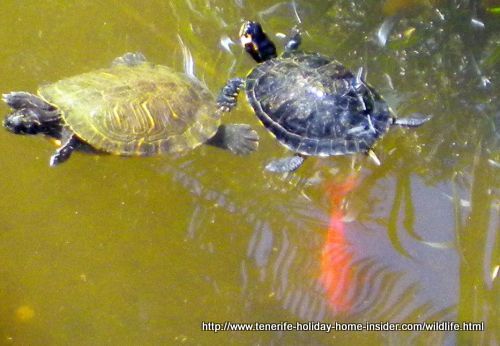
Aquatic turtles are not fit to be released into the wild when they were not born there.
Endangered
Hammerhead marine turtles (Tortugas Boba) which roam almost all ocean
sand often perish in fishing nets or by eating plastic, as confirmed
again by the CRFS Canary Rescue organization in El Medano in 2013
Some
of Tenerife turtles, such as from from Punta de Teno were successfully
relocated to the small bay of El Puertito o Caleta by Adeje
Edible fish like Doradas, Bonitas, Viejas, Trouper, Tuna, Sardines, eels, octopus, blue Marlin, Sting Rays
Any fish and fauna which love volcanic rocks and flora in temperate Altantic waters
Mind more seafood and edible fish listed for eating at Tambo Tenerife
with partly English translations such as for Rodavallo, Lubina,
Chicharros, Sama, Sargo, Lenguado for this fresh fish Restaurant of
Punta Brava.
Wild dogs in Tenerife
Yes, they exist and are mainly abandoned Podenco hunting dogs which is a disgrace. Any wild dogs can become a nuisance when they get rabid and roam as far out as in Teide national park. By the way, it's not permitted to feed them by Spanish law.
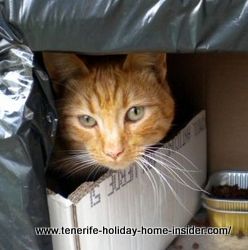
Wild cats in coastal, urban areas
Felix the wild tomcat from Calle Jasmin is depicted with his third makeshift street home that somebody made for him.
Some nasty person kept on demolishing it.
Felix only eats canine food. He stalked all dogs before he was neutered for free by the local vet.
A
little late, as it was impossible to catch him without a fishing net
on a pole. He tried to play-fight with all canines but above all with
small dogs, male or female alike.
Marvel at him below, as he tries to kiss ourembarrassed dog Jessy.
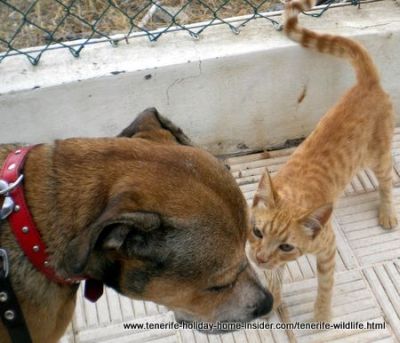
She normally ignored him but, one day it was her who gently touched his nose with her snout. However, playing with the cat would have taken matters too far for the old canine.
Felix
fully recovered from his free neutering. Now he is as playful and
friendly as before and he is only a threat to rats. He stayed wild but
even seems to share his food with another stray cat, off lately.
The just mentioned operation of Felix the cat was done by the German, English and Spanish speaking Tenerife vet of Clinica Veterinaria Toscal at C/Monturrio 21 in Longuera Longuera of Realejos who will also be there for your wild, i.e. "tamed" birds, snakes and other pets.
Other charitable German vets and cats
At some stage, the owner of Loro Park encouraged German vets to help to reduce the Tenerife wildlife of stray cats, since they had become too many. Now it's almost a custom for doctors to return from time to time to take care of new abandoned felines.
Endangered birds of Tenerife wildlife
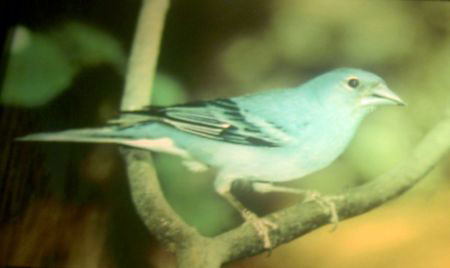
Museo del hombre y de la Naturaleza
- The Tenerife endemic blue Chaffinch
- The Pardela seagull which loses orientation because of street lighting
- The fish eagle
- Endangered birds such as mountain doves and the Barbary falcon in Masca
- Birds taken care of by the leading world parrot conservation of Loro Park
- Canary birds in urban areas by Puerto de la Cruz
- The endangered Tenerife Kentish Plover bird
Other Tenerife wildlife of birds
- Devils Gorge: Eagles, hawks, falcons, pigeons, doves, owls, Passer birds
- Aguilla park: Eagles, condors, malibus, macaws, flamingos, ostriches
- Loro Park Penguins and parrots(Loros in Spanish)
The Tenerife wildlife of native black pigs?
Nobody knows if the Guanche brought these scavenging bush and forest animals with the short coarse hair. There are no records either if they existed on Tenerife Ialand prior to the Neolithic natives.
Tenerife's Cabildo government is
still making efforts to augment the population of these endemic beasts.
In 2006, about 300 of pure black ones were counted. Their wildlife was
almost extinct on all Canary Islands by 1980.
However
now more farmers are interested in breeding them, as there is more
demand for their superb ecological meat as well as for 'slow food' as
opposed to unhealthy fast food.
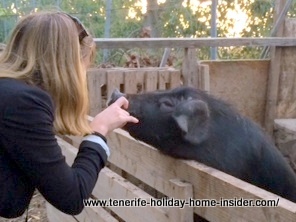
Depicted is a young native Tenerife black pig
of our friends. Mind it may reach anything between 150 and 200 kg
eventually. Here, the intelligent young animal is trying to make friends
with my daughter. It can also sense that she loves all animals.
Unfortunately, its big floppy triangular ears that reach below the chin and its big snout are hardly seen.
It
was in the news by middle of March 2015 that the Cabildo brought
several prize animals from its very own farm Helecho of Arico to
Pinolere in La Orotava. Tenerife North with its abundance of mountain
water is best for the black Guanche pigs.
Tenerife wildlife has only pet snakes
Tinerfe,
as Tenerife was called once, is officially snake free. Meantime, Gran
Canaria Island harbors some African intruder snakes. They managed to
sneak in on boats.
I almost forgot about my page on reef crabs Puerto de la Cruz by the Muelle jetty. Look at their photos and read on, but be warned, they are not the nicest of creatures...
How could a gigantic oil spill in the Mexican gulf affect Tenerife turtles?
It's a known fact that in 2010 a micro-chipped Loggerhead Turtle swam all the way from the biggest Canary Island to the Mexican Gulf. That endangered sea turtle loves to lay eggs in Tenerife, while the climate is good for its young ones to grow up. Later, the mature animals' instinct tells them to cross the Atlantic. Then they mate 6000 km away in the deep near the shores of the Southern States of the USA. No doubt that the spill of an exploded oil rig also may have done immeasurable harm for decades to the sea turtles' honey moon habitat by the gulf. Will the environmental damage
BP oil spill settlement of 2015 cover such wildlife?
Rhodophyta organisms found on Playa Jardin neither fauna nor flora
Red dragonfly of Jardin Botanico Puerto de la Cruz main botanical garden
A Tenerife holiday home where balcony whitefly control was an issue
From wildlife back to HomePage Tenerife holiday home insider

Please mind that the comment box below is meant to help others. In case you have a question or want to tell me something, kindly use this contact form.
This site is protected by Copyscape
Transfer wanted
in Europe?





Optica Columbus Best optician Tenerife North Important eye tests Call 922 387072
Insider


Note:
Text and images within this site are not to be copied or traded at any time. This regards online and offline.
Please respect my copyright
New! Comments
Have your say about what you just read! Leave me a new comment in the box below.